
India's cement demand has consistently shown double-digit growth over the past few quarters, primarily driven by infrastructure spending. However, dealers and industry executives note that state elections, festival season, and, in some markets, weddings and pollution may temporarily disrupt this demand story. While the festival season typically sees a slowdown in construction activity, some dealers anticipate this lull extending throughout the entire month as multiple states enter election mode.

The GST Council on Wednesday approved a two-tier rate structure of 5 and 18 per cent, which will be implemented from September 22.
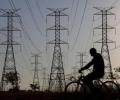
The growth of eight key infrastructure sectors slowed to a 15-month low of 3.6 per cent in January, on account of poor performance of sectors like refinery products, fertiliser, steel and electricity, according to the official data released on Thursday. The growth of eight core sectors -- coal, crude oil, natural gas, refinery products, fertiliser, steel, cement and electricity -- was 4.9 per cent in December. It was 9.7 per cent in January 2023.

Cement companies witnessed speculative support from investors through FY23 amid hopes of a rebound. After capex announcements in the FY24 Budget, there was further interest due to expectations that government expenditure would boost earnings, besides a generic macro-recovery. Cement earnings were under pressure in FY22 and FY23 due to high raw material and fuel costs; muted demand prevented them passing on the higher cost.

Only Cement is assessed to retail selling price based excise duty but denied abatement; also seeks imposition of import duty due to emerging surplus supply situation in India

The output of eight key infrastructure sectors slowed down to a five-month low of 2.9 per cent in February, as against 7.1 per cent growth registered a year ago, according to official data released on Friday. On a monthly basis, the production growth of the core sectors was lower than the 5.1 per cent expansion recorded in January.
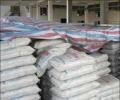
India's cement demand is expected to grow by over 10 per cent.
India has emerged as the second largest manufacturer of cement in the world, according to a latest report released by the Ministry of Commerce and Industry.

To shield against US President Donald Trump's tariff shock, analysts have been advising investors to focus on stocks of domestic-oriented companies, rather than export-centric ones, to minimise potential losses.

The production growth of eight key infrastructure sectors slowed to a six-month low of 7.8 per cent in November due to a decline in the output of crude oil and cement sectors. The growth rate in the production of coal, fertiliser, steel, and electricity also decreased during November this year. According to the data released by the government on Friday, the growth during the month under review, however, is higher than the 5.7 per cent recorded a year ago.
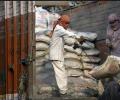
With another quarter of steady growth in demand, cement companies are expected to report strong year-on-year (Y-o-Y) growth in earnings, according to analysts. The September quarter (Q2FY24) also witnessed a resumption of price hikes in certain markets. UltraTech Cement, India's largest cement producer, reported a 15 per cent Y-o-Y increase in cement sales in the country for the quarter under review.
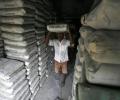
Even as cement companies continue to announce ambitious expansion plans, analysts turn cautious over the sector as incremental supply is expected to coincide with a weak demand growth period, and other headwinds of higher fuel costs, weak monsoons and general elections. In August, JSW Cement said it will take its current 19 million tonnes (MT) capacity to 60 MT in the next five years. The country's top producers have massive expansion plans underway - UltraTech Cement targeting 200 MT, Adani Cement aiming for 140 MT and Dalmia Cement planning for 110-130 MT.

The IPO wave of 2025 is here, and it's bigger than ever. From fintech unicorns to financial powerhouses and infrastructure giants, some of India's biggest names are all set to make their stock market debut. PhonePe, Zepto, Tata Capital, NSE, NSDL, and JSW Cement are just a few of the highly awaited listings that have investors and analysts buzzing with excitement.
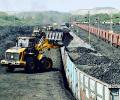
The output of eight key infrastructure sectors jumped by 12.1 per cent in October 2023 against 0.7 per cent expansion in the year-ago period on account of a sharp uptick in production of coal, steel, cement and electricity, according to the official data released on Thursday. These numbers assume significance as the eight core sectors -- coal, crude oil, natural gas, refinery products, fertiliser, steel, cement and electricity -- contribute 40.27 per cent to the Index of Industrial Production (IIP). Growth was primarily driven by a low base effect and double-digit growth in four sectors -- coal, steel, cement and electricity.

India's economy is expected to grow 6.4-6.7 per cent during the current financial year driven by strong domestic demand, even as geopolitical uncertainty poses downside risks, the newly appointed CII president Rajiv Memani said on Thursday.

Simplifying GST rates, removing exemptions, easing disputes, and speeding up refunds can boost investment in India and offer the best reply to Trump's tariffs, observes V S Krishnan, former member, Central Board of Indirect Taxes and Customs.

The output of eight key infrastructure sectors slowed down to 4 per cent in December 2024, as against 5.1 per cent growth registered a year ago, according to official data released on Friday. On a monthly basis, the growth rate in the production of these sectors was lower than the 4.4 per cent expansion recorded in November 2024.
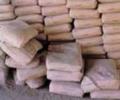
Hike in excise duty on cement products is negative, but can be overwhelmed by improved demand from greater thrust on infrastructure and rural sector.

Geopolitical developments between India and Pakistan, quarterly earnings and macro data will be the key drivers of stock markets in the holiday-shortened week, say analysts.
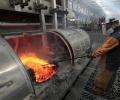
In the domestic segment, demand is currently led by rural markets, oil and gas, LPG and B2C segments like roofing and sheeting.

The output of eight key infrastructure sectors slowed down to 4.3 per cent in November 2024 against 7.9 per cent growth registered a year ago, according to official data released on Tuesday. On a monthly basis, the production growth of these sectors was higher than the 3.7 per cent expansion recorded in October 2024.

The MiG-21's sharp silhouette and supersonic roar will live on in the memories of those who flew it, those who maintained it, and those who watched it streak across the sky as a symbol of India's strength, asserts IAF veteran Air Commodore Nitin Sathe (retd).

Analysts expect Nifty to rise up by to 6 per cent in six months, with intermittent corrections likely due to global factors.

Passenger vehicle retail sales witnessed 3 per cent on-year decline in May with customers delaying purchases in several states due to India-Pakistan conflict and further softening of demand for entry-level models, dealers' body FADA said on Friday. The passenger vehicle registrations last month stood at 302,214 units, as compared to 311,908 units in May 2024.

The era where nations thrived through rigid alignments is giving way to an age where the connective State defines power. For India, that era has arrived, points out Dr Nishakant Ojha.

Andhra Pradesh will establish two expansive integrated space cities in Lepakshi and Tirupati, spanning around 33,000 acres.

Cement companies posted mixed figures for the first quarter of the 2023-24 financial year (Q1FY24). Volume growth was robust at 17 per cent year-on-year (Y-o-Y) - on an aggregate basis - for 15 cement companies, with revenue growth at 15 per cent. Aggregate earnings before interest, taxes, depreciation, and amortisation (Ebitda) were up 8.8 per cent Y-o-Y and 1.2 per cent quarter-on-quarter (Q-o-Q).
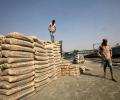
The sector may be overcrowded with a fair number of large players and the entry of the Adani Group through its two key acquisitions, followed by the takeover of majority stake in Sanghi Industries via Ambuja Cements. Since every major player is in expansion mode, there could be a capacity surplus and hence, price wars.

India's trade relations with Turkey and Azerbaijan are expected to come under strain due to Ankara and Baku backing Islamabad and condemning India's recent strikes on terror camps in Pakistan. Following their support to Pakistan, calls for boycotting Turkish goods and tourism have surfaced across the country, with online travel platforms such as EaseMyTrip and Ixigo issuing advisories against visiting these nations.

The output of eight key infrastructure sectors expanded by 3.1 per cent in October 2024, sharply down from a 12.7 per cent growth registered in the same month last year, according to official data released on Friday.

Fada estimates that global supply chain headwinds like scarce availability of rare earth elements for electric vehicle components and geopolitical tensions may affect urban consumer sentiment in June as well.

From the Sensex firms, Reliance Industries, Tech Mahindra, Eternal, HCL Tech, Infosys, IndusInd Bank, Tata Consultancy Services and Bajaj Finserv were the biggest gainers. In contrast, UltraTech Cement, Sun Pharma, Power Grid, NTPC, Kotak Mahindra Bank and Mahindra & Mahindra were among the laggards.

Corporate India is starting to step up its capital expenditure plans amid government incentives and signs of rising demand, company executives and analysts have indicated. This coincides with the Reserve Bank of India (RBI) recently citing a double-digit growth in private capital expenditure. Healthy balance sheets of banks and corporates, along with increasing capacity utilisation and improving business sentiment, are contributing to a favourable environment for sustained growth in private sector investments, the RBI said in its policy last week.
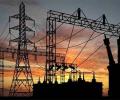
The growth of eight key infrastructure sectors slowed down to a 4-month low of 8.1 per cent in September 2023 against 8.3 per cent a year ago, according to the official data released on Tuesday. The growth rate in the output of refinery products, fertiliser, cement and electricity during the month under review has decelerated, while it was negative in the case of crude oil. The previous low was in May, when the growth rate of these sectors stood at 5.2 per cent.

India and the UK on Tuesday sealed an ambitious free trade deal along with a double contribution convention with Prime Minister Narendra Modi saying that the landmark pacts will catalyse trade, investment, growth and job creation in both the economies. Modi made the announcement on the agreements after a phone conversation with his British counterpart Keir Starmer.
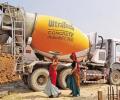
UltraTech Cement's results for the fourth quarter results of the 2022-23 financial year (Q4FY23) were broadly in line with the Street estimates. The consolidated revenue, operating profit and net profit stood at Rs 18,700 crore, Rs 3,300 crore and Rs 1,670 crore, respectively, which were up 18 per cent, 8 per cent and 13 per cent YoY, respectively.

JSW Steel, owned by Sajjan Jindal, has emerged as the world's most valuable steelmaker, boasting a market capitalisation (mcap) of nearly $30.31 billion, according to Bloomberg data.

Foreign brokerages remain cautious on the road ahead for the Indian equity markets. Though analysts at Nomura have revised their March 2026 Nifty target to 26,140 levels from the earlier 24,970, but the upside from the current levels is a modest 6 per cent. BofA Securities, on the other hand, has not made any change to its year-end Nifty target.

Billionaire Gautam Adani's son Karan will helm the cement firms his group has acquired to become India's second largest cement player and extend his burgeoning empire that spans from ports and energy to airports and telecom.
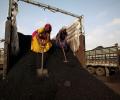
The growth in production of eight key infrastructure sectors entered a negative zone after three-and-a-half years, contracting 1.8 per cent in August 2024 due to decline in output of coal, crude oil, natural gas, refinery products, cement and electricity, according to official data released on Monday. The growth rate was 6.1 per cent in July. The growth of core sectors -- coal, crude oil, natural gas, refinery products, fertiliser, steel, cement and electricity -- was 13.4 per cent in August 2023.
